Tuesday, November 19, 2013

People

It's always fun to take pictures of people. Here are a few.

"Want some food from our food truck?"

X-Ray girl


Working at a food tent on Culture Day

This guy thought it was funny that I wanted to take his picture.
He has two fingers in the sideways "Peace" sign,
but why he put them in front of his face I can't figure out.
Oh, well.

Sketching a garden scene (watercolors, I think)

Does this need any explanation?


Hanging out in Yoyogi park


Mother and son sharing a quiet moment with tea.

An American ex-pat singing songs in English and Japanese.
He saw my Boston Red Sox cap, but said that he didn't follow baseball.
A Japanese listener saw my cap and said "Koji Uehara" and started clapping.
The Japanese love Koji.


Monday, November 18, 2013

Buddhist Temples

Buddhism originated in India and spread to China and Korea before arriving in Japan in the 6th century CE. After some fits and starts it secured a strong foothold in Japan alongside the Shinto religion. Many people in Japan visit both Shinto shrines and Buddhist temples.


Yasaka-jinja (Shinto) Shrine, Kyoto
Senso-ji (Buddhist) Temple, Tokyo
 I've often thought of Buddhism as a philosophy more than a religion. Many people in the United States consider themselves Buddhists without considering themselves religious. I was surprised, therefore, to learn about the Buddhist gods. Most have their beginnings in the Sanskrit (Indian) pantheon but have been adapted by the Japanese to better fit their culture.

Photo of a statue at Sanjusangen-do Temple in Kyoto.
Printed in a booklet from the Temple.


Originally a crocodile in the Ganges River known as Kumbhira it was adopted in Buddhism as a guardian deity of the Buddha.


Buddhism is also not monolithic. I had heard of Zen Buddhism, but according to Wikipedia, there are two (or three) "major branches." Within one of the branches there are six "traditions," one of which is Zen. Then there are thousands of "schools" of Buddhism, all teaching different things. And guess what? They all build their own temples, they all have their own priests and they all teach different things. (I don't have any sense about conflict, if any, between various sects and dogma. They seem to get along, because a Temple may have many different sub-temples on their grounds.) 

Raijin (Varuna) God of Thunder.
Photo of a statue at Sanjusangen-do Temple in Kyoto.
Printed in a booklet from the Temple.


Also, Buddhism adapts. As its theology developed in Japan, it incorporated elements of Shintoism. In particular, it looked at the Shinto gods and decided that they were indigenous versions of Buddhist gods. This meant that if you worshiped a Shinto god, you were actually worshiping a Buddhist god without knowing it, so you were Buddhist all along.


Where shrines have torii, temples have gates, with heavy doors and raised sills. Like the torii, they are symbolic gates, but they have a more substantial feel to them.

People who visit temples also go through purification rites very similar to the Shinto shrines. They use the same ritual for purifying their hands...


...but they add a purification by incense, where they pull the smoke towards themselves. The smoke is supposed to have a healing virtue.
Senso-ji Temple, Tokyo
Worshipers can also buy pre-printed prayers to tie onto racks...
Zojo-ji Temple, Tokyo
...as well as wood shingles where they can write their prayers.
Zojo-ji Temple
But that's where the similarities end. The temples usually have seating areas for quiet meditation where you can contemplate the buddha statues.

They are also much more ornate.
Zojo-ji Temple
Shoren-in Temple, Kyoto
Finally, Buddhism has a theology surrounding death, and so some temples incorporate cemeteries within their walls. (Shinto shrines never do.)
Yanaka Cemetery, Tokyo

These are Jizo statues given by people who have had miscarriages, stillbirths or abortions. (See Wikipedia for more.)
Zojo-ji Temple


Oh, and one other difference between shrines and temples: shrines are always free to visit while temples usually charge admission.

Here is a slide show of Senso-ji Temple in Tokyo.

Sunday, November 17, 2013

Shinto Shrines

Shintoism is the indigenous religion of Japan. It was well-established before Buddhism arrived from China and Korea in the 6th century. Shintoists revere ancestors as well as gods that are present in the natural world, whether in a rock or a hill or a waterfall. It has no codified scripture or code of ethics, but the Japanese respect for elders (and ancestors) and family is a strong reflection of Shintoism. It is a religion of the living, with no concept of an afterlife. Many Japanese have a Shinto wedding and a Buddhist funeral and practice rites of both religions.

The Meiji-jingu shrine is the "grandest" and busiest shrine in Tokyo. It is not old, having first been built in 1920, destroyed in World War II and re-built in 1958. It is the place where people go: on New Year's Eve as many as two million people gather there.

You approach the shrine on a wide path through the woods that were once part of the Imperial grounds.

The entrance all shrines is a torii. It is usually made of wood, but can also be stone or concrete. Its most basic form is two posts and two lintels. It is a purely symbolic gate (separating the profane of the outside from the sacred of the inside) rather than a functional one.


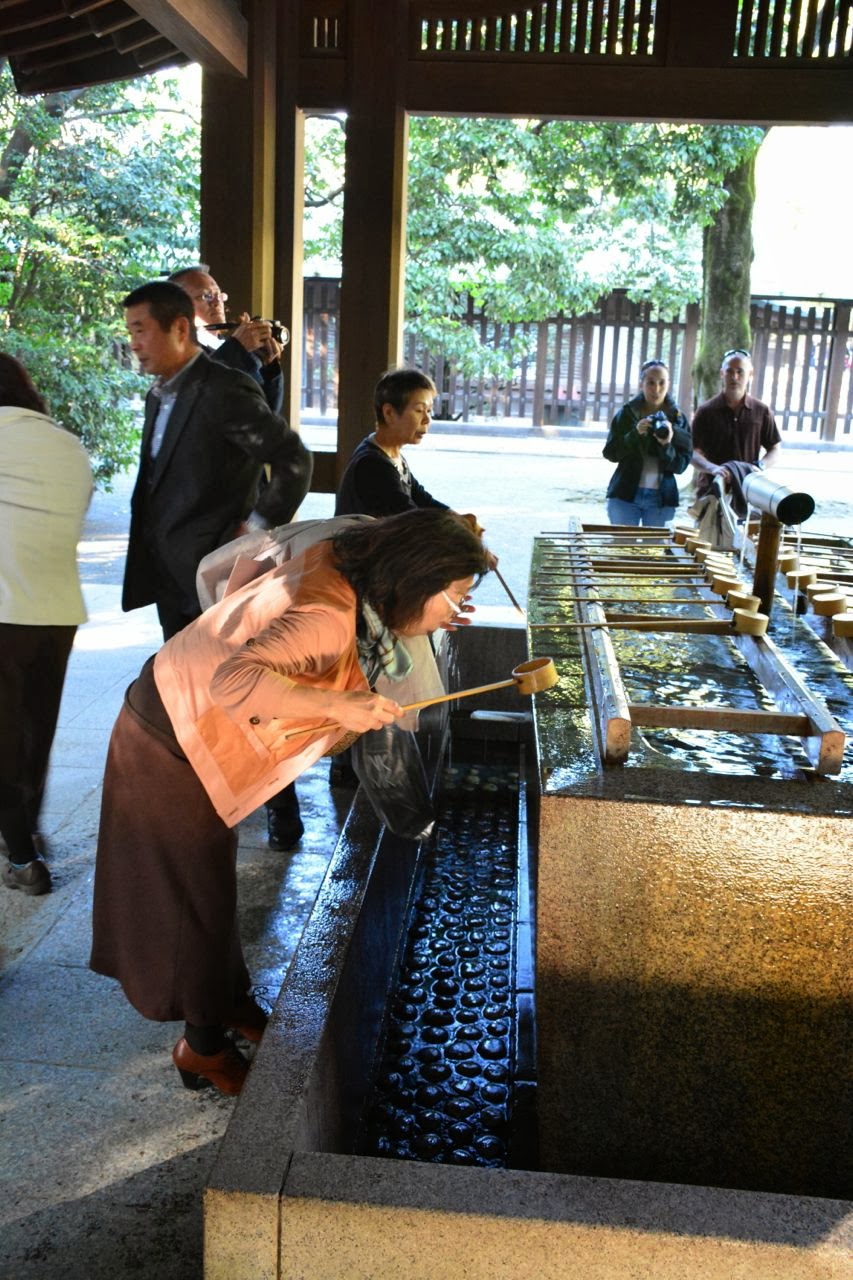
Once inside, you then purify yourself with water. There are ladles by a trough of water. You take some water in the ladle and pour it over one hand, then transfer the ladle to the other and pour it over the other hand.

Then, taking fresh water from the water flowing into the trough, you pour it into your hand and rinse your mouth. Finally, you spit it out onto the ground.

Now you go to the front of the main hall. You stand under the roof of the hall but you do not go into it.


You toss a coin into a wooden box covered with slats that make a distinctive sound. In some shrines you pull on a rope to ring a gong; this gets the attention of the god.


You then clasp your hands together and pray a short, silent prayer describing your wish. Now you clap your hands twice (not once, not three times!), bow, and then back away.


And that's it. It's quick and easy. Some people go to shrines on their way to work, praying (presumably) for "luck" in their workday. (We could all use that!)


There is a Shinto priesthood, but it seems they rarely interact with worshippers. There are rites inside the shrine, conducted only by the priests; during this time, "No photography" signs are posted. When the priests are absent, the signs are (sometimes) taken away.

Another option at a shrine is to buy pieces of wood on which you write your prayer and then hang on a rack.


Or you can take a prayer pre-printed on a piece of paper and tie it to a tree branch.


Many people dress up their children and bring them to shrines on special occasions. One such festival is the Shichi-go-san which means literally "Seven-five-three."  Parents bring their 7-year old, 5-year old and 3-year old children to the shrine.  I got a number of photos of children dressed for other special occasions.


People often get married at Shinto shrines. I know nothing about the ceremony, but there was one the day I went to the Meiji-jingu shrine.


For more pictures of shrines see: Shinto Shrines.